Showing posts with label presence. Show all posts

Tuesday, August 5, 2025

Choose Your Own Mantra

My daily practice is the intention to stay present, to notice when ego's monkey mind takes over and—as in sitting meditation—come back to the present.

Often this means recognizing such triggers as anger, envy, hurt, or judgment and staying with the emotion, using what Stephen Cope in The Wisdom of Yoga refers to as restraint: ". . . the beginning of a process in which a pattern dies – beginning with the outward and visible gross behavior, and culminating with the death of the root of the pattern . . . These patterns, of course, take years or even lifetimes to be attenuated. But with each subtle attenuation comes an increasing sense of freedom and energy."

I've also used mantra meditation for many years, since I found the book Choose Your Own Mantra. Chanting (sometimes singing) a mantra can support your intention to be mindful.

In Sanskrit the word "mantra" is derived from two words—manas, "to think/mind," and trai, "protect/free from." Thus, the literal meaning of mantra is "to free from the mind." A mantra produces an actual physical vibration and carries high energy.

Because Choose Your Own Mantra is no longer in print (some used are available), I offer readers a few possibilities to consider. (I recommend the Sanskrit instead of English because words in our own language have images that cause the mind to wander): 

OPEN WILL 
Om So'Ham (ohm soh-hum)—liberation from limitations of the body and lower mind.

Om Namo Narayanaya (OHM' nuh-MO NAH-RAI-uh-NAI-uh)—total liberation, the ability to dissolve obstacles resulting from egotism.
A great sage gave this mantra to his disciple, instructing that those who were not worthy should not hear it. The disciple immediately went onto the temple top and shouted it for all to hear. When the sage questioned his disobedience, the disciple replied, "I do not mind undergoing suffering if all these people can be freed."
OPEN HEART 
Om Namo Bhagavate Vasudevaya (ohm nuh-MOH b'huh'-guh-vuh-TEY VAH-soo-dey-VAI-uh)—invitation to Divine love.

Om Sri Kalikayai Namah (ohm shree KAH-lee-KAH-YAI nuh'-muh)—grants mercy, in the manner of a loving mother to her child.
OPEN MIND  
Om Sri Maha Saraswatjai Namah (ohm shree muh-HAH suhr-uh-swuht-YAI nuh-muh)—deep study, mystical and academic wisdom. 

Om Sri Maha Lakshmiyai Namah (OHM shree muh-HAH luck-shmee-YAI nuh-muh)—serenity of mind, humility, compassion.

Saturday, May 11, 2024

Open Will, Open Heart, Open Mind

In his book Keys to the Enneagram: How to Unlock the Highest Potential of Every Personality Type, A.H. Almaas writes about "a Fourth Way approach of bringing the full intelligence of the centers to whatever phenomenon [arises] in our consciousness." 

Inviting awakening from the gut, heart, and head centers entails "grounded presence, openheartedness, and a willingness to experience with an open, receptive quality of mind." 

This is ancient knowledge that Enneagram enthusiasts too often miss in focusing overmuch on the nine "types" or ego ideals.

Otto Scharmer has shown a parallel between opening the will, heart, and mind with seven sacred teachings from an aboriginal community — bravery/courage, respect/love, humility/honesty/truth:
  • bravery/courage (open will: relaxing into the unknown vs. fear),
  • respect and love (open heart: compassion vs. cynicism),
  • humility/honesty/truth (open mind: curiosity vs. judgment).

"K" is for Krishnamurti

The devil and a friend were walking down the street, when they saw a man stoop to pick up something from the ground, look at it, and put it away in his pocket.
The friend said to the devil, "What did that man pick up?"
"He picked up a piece of the truth," said the devil.

"That's a very bad business for you, then," said his friend.

"Not at all," the devil replied, "I'm going to help him organize it."
This was a favorite story of Jiddu Krishnamurti, fondly remembered as "K" by community members of the Krishnamurti Centre in England, where I worked as a co-op for two weeks several years ago.

K maintained that "Truth, being limitless... unapproachable by any path whatsoever, cannot be organized, nor should any organization be formed to lead or coerce people along a particular path."

Imagine the paradox Krishnamurti then faced: trying to teach the unteachable. He came to this pathless path years after being "discovered" in adolescence by leaders of the Theosophical Society and groomed to be the World Leader of what later became the Order of the Star.

After experiencing his own process, a state of clarity I would call presence, he realized he could only embody the teaching by not being a leader. His proclamation met with dismay within the Order, but to me is the ultimate example of "walking the talk":
"I do not know how many thousands throughout the world -- members of the Order -- have been preparing for me for eighteen years, and yet now they are not willing to listen unconditionally, wholly, to what I say... You use a typewriter to write letters, but you do not put it on an altar and worship it." (Proclaimed leader in 1912, disbanded the Order in 1929).
Krishnamurti frequently claimed that the great religious teachers had come not to found religions but to destroy them, and throughout his life he asked questions of his audience to lead them toward discovering the path within themselves. 
"In oneself lies the whole world and if you know how to look and learn, the door is there and the key is in your hand. Nobody on earth can give either the key or the door to open, except yourself."

Saturday, December 17, 2022

I Grok Spock

"Grok means to understand so thoroughly that the observer becomes a part of the observed — to merge, blend, intermarry, lose identity in group experience. It means almost everything that we mean by religion, philosophy, and science — and it means as little to us (because of our Earthly assumptions) as color means to a blind man." Wikipedia quoting Robert A. Heinlein, Stranger in a Strange Land.
Michael, the hero of Stranger in a Strange Land, was born on Mars — where grokking was taken for granted. So he was unencumbered by the barriers to intuition many humans encounter. As an example, he grokked grass before walking on it to ensure he was not causing another creature pain.

Grokking seems such a natural concept and so appropriate to any conversation about presence
— one can't logically explain exactly how to do it, but I think we're all capable of envisioning a connection so deep we are both one and all. I like Fred Lamotte's definition of grokking because it's more trusting of humankind's ability than Heinlein's suggestion that it means as little to us as color to a blind man:

‘To grok' is . . . the best Western term I have ever encountered for what in Sanskrit is called ritam bara pragyam: that subtlest level of energy that ripples on the verge of transcendental silence where all things are grasped as a whole before they become manifest in the multiplicity of the material world.

I've always considered the Vulcan mind meld to be a form of grokking - again, we must leave the Earth to find beings for whom such a deep connection comes naturally. So, I was delighted to find there's still a craze for "I Grok Spock" t-shirts. Why is that I wonder? Possibly because we are the strangers in our own land, longing to be able to grok, to meld.

What a combination--a deep mental understanding (which also requires physical contact) aligned with a complete emotional-intuitive awareness of another: body, mind and heart attuned.

Imagine! 

Thursday, August 18, 2022

I See You

When I saw the film, Avatar, I was, of course, entranced by the fabulous technology. What stuck with me the most, however, was how the Na'vi on Pandora greeted each other: "I see you." The meaning of this phrase goes beyond the simple act of visual recognition; rather, it communicates, "I see into you, I see and acknowledge and honor who you really are."

In her Skin in the Game blog entry, Mutual Gaze, Sara K. Schneider describes how Buckminster Fuller returned the greeting Hello, how are you? with the reply, I see you... "a customary greeting in the central African highlands... the most intense of our mutual gazes imply deep connection, as well as the opportunity for sitting with both the dignity of our separateness and the beauty of our oneness."

Early in my coaching career, when I found myself disliking the behavior or values of a client, I would visualize myself bowing and giving the traditional Indian greeting, Namaste
(acknowledging "the spark of the divine" in another) - as a symbol of my desire to be present to the person, without judgment.

What better way to remind ourselves to be fully present?

Namaste.

I see you.


Wednesday, March 30, 2022

The Yin and Yang of Presence

Any problem you encounter can either feed your old, destructive patterns or provide an opportunity for major growth. A primary goal of change is "waking up" to habitual patterns. 

Borrowing from Stephen Gilligan (Summer 1999 Milton H. Erickson Foundation Newsletter, page 8), full presence requires both yin (receptive) and yang (active) qualities:
In the yin mode, providing sanctuary, listening deeply, receiving with curiosity and open heart, and bearing witness with kindness and understanding.
In the yang mode being relentlessly committed to your spiritual growth, attending fiercely, guiding, setting boundaries, and challenging self-limitations.

Our yin/yang balance can be lopsided if yang is overly activated by a prolonged sense of danger or other stresses. When this happens, we need to invite more yin with time for healing and regeneration.

A moving meditation such as qigong can heal gut, heart, and mind energies, to provide physical health, open the heart, and bring spiritual clarity.


Monday, March 14, 2022

A Leap of Imagination

Presence: An Exploration of Profound Change in People, Organizations, and Society illuminates an approach to change that Tim Flood and I developed, based on the premise that staying completely within metaphors is an exciting and powerful way to bring about personal transformation.

Metaphor-driven change work also requires the coach to be fully present. But what is presence?
We first thought of presence as being fully conscious and aware in the present moment. Then we began to appreciate presence as deep listening, of being open beyond one's preconceptions and historical ways of making sense We came to see the importance of letting go of old identities and the need to control... leading to a state of "letting come," of consciously participating in a larger field for change (Peter M. Senge, C. Otto Scharmer, Joseph Jaworski, Betty Sue Flowers: Presence, pp. 13-14).
Spontaneous presence is absent of all preconceived notions, all self-talk, all assumptions and beliefs. It is trust in a knowing that has nothing to do with logical efforts. This knowing is absolute, unmistakable, and has a kind of magical quality.

The authors of Presence describe organizational examples. Here are two personal examples.

"Cloisonne Vases," by Mary Bast
In January 2008 I signed up for an oil painting class, purely from a desire to understand the medium so I could better appreciate works of art. To my utter amazement I found an affinity for painting, a complete engagement in the process: from preparing the canvas and setting up the palette to cleaning the brushes at the end of the class. I brought no expectation of being a "good" or "bad" painter, no preconceived notions, no need to control the outcome. By the end of the first year, I had completed a large painting of two Japanese cloisonne vases that had been in my family since my military father was stationed in Japan in the 1940's. I felt as if the canvas painted itself and I was the vessel of its creation by virtue of holding the brush in my hand. No one is more astonished than I to see the beauty and depth of those vases that "I" painted.

My second example happened when Tim Flood and I were finalizing the materials for a conference play-shop about metaphors. We wanted to keep people moving and out of their left-brain preconceptions without a lot of talk/direction on our part, so we envisioned notebooks that could hang from ribbons around their necks with clear instructions for each next step of the process. We used every kind of logic to figure out the length of the ribbon, how to attach a pen, etc. but -- no matter what we did -- when testing the prototype the ribbon pulled the binding loose from the notebooks. Finally, when we were feeling "brain dead" (a good thing, as it turned out), I started laughing hysterically. Tim thought I'd gone completely off my rocker. When I could speak, I shared the image of a kangaroo with a pouch, my internal judge translating it as something "silly." But as I slept that night my self-critic also slept, and I awakened the next morning with the clear image of a two-pocket folder that could be converted, with a little snipping, into two "pouches." We had our solution.

Thursday, October 27, 2016

Creative Listening


In the executive summary of Theory U: Leading from the Future as it Emerges, Otto Scharmer writes:
Why do our attempts to deal with the challenges of our time so often fail? Why are we stuck in so many quagmires today? The cause of our collective failure is that we are blind to the deeper dimension of leadership and transformational change. This 'blind spot' exists not only in our collective leadership but also in our everyday social interactions. We are blind to the source dimension from which effective leadership and social action come into being. ("Addressing The Blind Spot of Our Time").
To access the source dimension, Scharmer suggests we slow down our listening, moving from the limitations of downloading ("Yeah, I already know that") and factual listening (the scientific approach, noticing what differs from what you already know), and even past empathic listening (knowing how the world appears through someone else's eyes), to generative listening (attending to the emerging field of future possibility).


Wednesday, August 25, 2010

Think in the Beauty Way

In Be Careful What You Pray For, Dr. Larry Dossey describes the Navajo belief in the power of words, the importance of positive thinking and speaking in "The Beauty Way."

Dossey, a physician and researcher who has helped bring credibility to alternative therapies and to spirituality in medicine, distinguishes between 'loosely coupled systems' and  'tightly coupled systems.'

A lawnmower's gasoline engine is a loosely coupled system -- the parts are relatively autonomous and can be individually replaced when they malfunction. Far too many physicians treat their patients as if a physical malfunction is much like a faulty lawnmower part. Instead, human bodies are tightly coupled systems and highly interdependent.

So while doctors don't usually intend to do us in, the harm is nonetheless real when they make such pronouncements as "You're a walking time bomb" or "There's nothing more I can do." 

In contrast, researchers at Dartmouth Medical School have found the factor most highly correlated with survival and a positive post-operative course after surgery is the degree of spiritual meaning in a person's life. 

Whatever crisis you face, medical or otherwise, think in The Beauty Way. Ask yourself: 
How can I participate in my mental and physical health and not be a victim?

What is my purpose?

What is meaningful to me?

How might I make a difference in the world?

Saturday, May 15, 2010

Dancing to a Larger Dance

Guest post by Tim Flood:

In The Presence Process Michael Brown argues that significant, authentic change can only be achieved by a full excavation of the psyche -- from external projection, back through behavioral and intellectual biases, to the emotive patterns that have kept the whole show up and running.

Though this may be old news, it comes alive again with presence as its vehicle and with metaphors bridging between behavior, thought processes, and emotive patterns. Presence is the nurturing receptivity essential to what Brown calls our witness-observer, and metaphors are the language of presence.

A transformative metaphor reduces resistance to zero by including and accommodating our complex emotional, intellectual, and physical patterns. Metaphors are the voice, the song, and the dance of the witty, kind, and intelligent inner observer. 

Listen for the rich and various ways people express themselves in metaphor:
I don't want to get to the end of my life and find that I have lived just the length of it. I want to have lived the width of it as well. Diane Ackerman
Now listen for your own metaphors. Be present to yourself.

Monday, April 19, 2010

The Pattern That Connects

"Premonitions open us up to each other and to the greater world... they show that we are part of something larger than the individual self, that we are an element in the great pattern that connects." Dr. Larry Dossey
The opening story of Malcolm Gladwell's Blink: The Power of Thinking Without Thinking should convince even the most skeptical that there are ways of knowing beyond the ability to make logical connections:
"A team of experts with state-of-the-art measurement tools took more than a year to assure the authenticity of a supposedly ancient Greek statue the Getty Museum of California was going to purchase for $10 million. Then several art experts looked at the statue and knew instantly it was a fake. One said he "heard" the word fresh, which seemed odd to him, but on further examination he realized the statue was too "fresh" to be that ancient." (David Brooks, New York Times).
We all have the capability to access these versions of a "sixth sense" although many shy away from that possibility, especially those who fear the unfamiliar. Even the word premonition carries an aura of foreboding - that something "bad" is going to happen.

When we're fully present, however, the possibilities are neither good nor bad, we're simply open to a broader context of knowing, a larger "mind" or "field" as others have named it. One of my experiences is described in The Archives of Scientists' Transcendent Experiences.

Whether you experience this knowing as a feeling in your bones, an image, or a nagging thought, it is saying to you, in Larry Dossey's words, "Wake up. The evidence for a larger world is staring you in the face."

Thursday, February 11, 2010

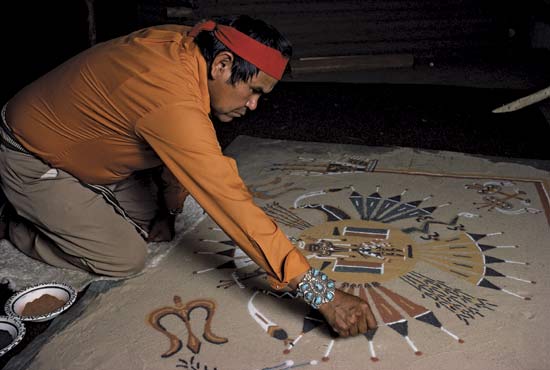
Sand Mandalas

What is the essence of presence? Perhaps it is having no desire to control. Thus the sand mandala.

Now often demonstrated by the Dalai Lama and groups of Tibetan monks, the ceremony begins with chants, music, prayers, and then pouring millions of grains of sand in bright colors from a metal tube called a chakpu. The finished mandala is about five by five feet in diameter, and takes three to five days to complete.

The creation process concludes with a consecration ceremony, and then... they dismantle the mandala!


For those of us who have become attached to our creations (our life, our image, our successes) this is astonishing, and we have much to learn.

Formed into traditionally prescribed Tibetan iconography that includes geometric shapes and historical Buddhist symbols, the sand mandala is a tool to consecrate and bless the earth and its inhabitants. The dismantling of the mandala symbolizes the impermanence of all existence.

Wednesday, January 20, 2010

Beyond Stereotypes: Presence in Law Practice

True presence is absent of preconceived notions, and that includes stereotypes. Among others, lawyers have suffered from innumerable jokes that caricature them in stereotypical ways.

So I am delighted to say the best definition of presence I've found was created by CUNY Law Professor Victor Goode and Jeanne Anselmo, RN, author of chapter 15, "Relaxation" in Holistic Nursing: A Handbook for Practice.

Their presentation, "Law in the Service of Human Needs: Social Justice and Contemplative Practice," defines presence as a contemplative skill:
"Therapeutic Presence assists students and attorneys to bring a centered, grounded, open, aware, active, concerned connection with one's self, one's client and the environment. It is not detached, nor is it numbing out, but rather is remaining as fully present as possible in the face of chaotic, difficult and challenging circumstances."
To achieve this state, we develop awareness and trust in our own purpose and process, self care and self reflection, and deep listening. Borrowing from Goode and Anselmo's presentation, these steps are key:
  • Ground Yourself: Stand comfortably, breathe deeply and drop your breath to your center of gravity in the lower abdomen.
  • Center Yourself: Connect to your intention for the interaction and your deeper commitment; allow your personal and professional resources to arrive in the moment (spontaneously vs. planned).
  • Listen Deeply and with Compassion: Seek to understand the other person without judgment.
To Goode and Anselmo: Bravo, Brava!!!

Sunday, December 6, 2009

Leadership Presence Assessment

Assess your leadership presence below, as defined in Leadership Presence: Dramatic Techniques to Reach Out, Motivate, and Inspire:
  • Being Present: Are you completely in the moment and flexible enough to handle the unexpected?
  • Reaching Out: Are your relationships with others developed through empathy, listening, and authentic connection?
  • Expressiveness: Do you express feelings and emotions appropriately by using all means of expression (words, voice, body, face) to deliver one congruent message?
  • Self-Knowledge: Are you accepting of yourself, authentic, and living your values in your decisions and actions?

I Saw Myself


I saw myself
a ring of bone
in the clear stream
of all of it

and vowed
always to be open to it
that all of it
might flow through

and then heard
"ring of bone" where
ring is what a

bell does

Lew Welch